Sushi Yoshitake (Masahiro Yoshitake) - Tokio
Sushi Yoshitake - 3, 2, 0
Masahiro Yoshitake enjoys an excellent reputation. His eponymous sushi-ya in Tokyo held three Michelin stars for ten years. As early as 2010, he opened Sushi Shikon, an outpost in Hong Kong, which became the first sushi restaurant in Asia outside Japan to be awarded three Michelin stars as well. Sushi Shikon retains that distinction to this day. Which is curious, because the mother ship lost its own three-star status in 2022. Since then, among Tokyo’s many sushi-ya, only Harutaka has been able to boast the guide’s highest honour. After Yoshitake was initially demoted to two stars, the stars disappeared entirely from the small counter restaurant in the glittering Ginza district the following year.
Other famous sushi-ya had already vanished from the Michelin guide before Yoshitake. In some cases, because it had become impossible for the general public to book a seat - Sushi Saito and Jiro being the obvious examples - or, as rumours had it, because the restaurants themselves had asked Michelin no longer to list them. Nothing of the sort was said or written about Yoshitake. Not exactly the best omens for a visit. But in Japan, much happens behind closed doors.
Beyond Michelin, Japan also has the immensely popular and seemingly trust-anointed review platform Tabelog. Unlike Western community-rating portals such as TripAdvisor or Google Reviews - both of which are, by now, known to merit a healthy degree of suspicion - Tabelog enjoys an excellent reputation among both locals and tourists. Why does that matter? At the time of my booking, Sushi Yoshitake held a score of 4.14 out of 5 on Tabelog and received the platform’s Bronze Award in 2025. That places it among the thirty best sushi restaurants in Tokyo. To be sure, that is a substantial drop from a place that Michelin only recently regarded as the city’s finest sushi counter. But once one considers that Tabelog lists 5,113 sushi restaurants in Tokyo alone, it remains a more than impressive rating. In many restaurants within that top thirty, it is now nearly impossible to secure a seat at all.
Many famous restaurants in Japan no longer accept reservations from new guests, serving only regulars. If you happen to know one, you may perhaps be able to tag along as a plus-one. Highly rated sushi-ya - and other restaurants too - have also increasingly stopped accepting reservations from non-Japanese diners. Or, if they do, only on the condition that they are accompanied by a Japanese speaker. The pathways through the reservation jungle of top Japanese restaurants are often inscrutable and strewn with frustrating obstacles.
But back to Yoshitake. Here, as a non-Japanese-speaking solo diner, one can still get a seat. Japan now has a small number of online concierge services that make reservations at sought-after restaurants possible. With a little flexibility, a seat at Yoshitake’s counter can be booked relatively easily through Tableall. For a corresponding fee, naturally. And this seat is indeed at the main counter, where Masahiro Yoshitake still works with his own hands. That is one of the principal reasons why I decided to eat here.
A number of notable sushi masters, Yoshitake among them, have for some time offered what is known as a “second counter.” This second counter - often dismissively referred to as the “tourist counter” - is run by a disciple of the master. Unlike the chef himself, this understudy often speaks English. It allows the restaurant to serve guests who, for the reasons mentioned above, can no longer or will no longer be accommodated at the main counter. At first glance, that may seem strange, or even xenophobic. In most cases, however, it is probably not rooted in that at all. After spending a longer period in the Land of the Rising Sun and visiting many restaurant, I can understand why some places have adopted these practices. Tourists behaving badly are an everyday occurrence. Even the simplest rules of courtesy - punctuality, for example, or the request not to bathe oneself in strong perfume - are routinely ignored.
Why these rules matter becomes abundantly clear in a place like Sushi Yoshitake. Eight people sit pressed closely together, shoulder to shoulder, along the counter. Sushi, like Japanese haute cuisine more generally, is usually defined by delicacy of flavour. A heavily perfumed neighbour quite literally spoils the pleasure. As far as I am concerned, this policy should be extended: no clouds of fragrance in restaurants, full stop. But that’s just by the way. Sushi-ya often run two seatings per evening. All guests begin together. Punctuality is therefore not merely a question of politeness but essential to the timing of a shared ritual. And, ultimately, it is also a mark of respect towards the sushi master, his staff and the other guests.
In order to protect the atmosphere, the food and the experience of fellow diners, Yoshitake now enforces a strict no-photos, no-videos policy. This is made clear several times in advance of the visit, just as the demand for punctuality is. When my Australian neighbour arrives late and then places his iPhone on the precious and pristine cypress counter, the staff immediately admonish him to put it away in a bag. They take it seriously here.
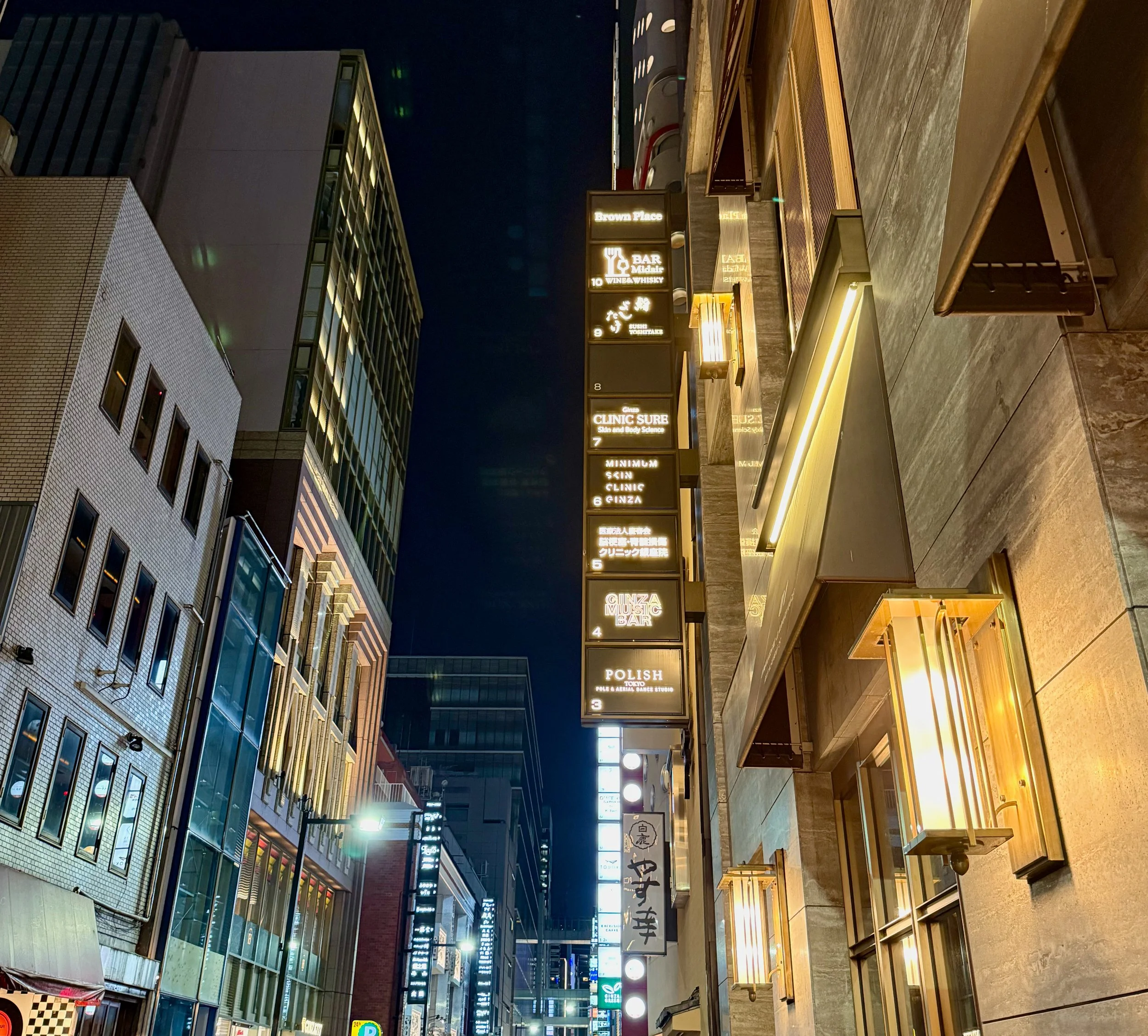
In order to meet that seriousness with the necessary calm, and to guarantee my own punctuality, I have already begun my evening an hour earlier, one floor above the restaurant. At Bar Midair, accompanied by soft jazz - still a popular soundtrack in many Japanese bars - one finds, alongside a view of Tokyo Tower, above all an excellent wine list. After two or three glasses, I am hungry and head downstairs punctually at 8:45 p.m. The seating itself begins only at 9:00, but guests are asked to arrive fifteen minutes early. Together with a couple from Taiwan, I am welcomed briefly in a waiting room scarcely more than two metres by two, and asked for my name. The sliding door then closes again before first the young couple, and then, once the door has shut again, I am ushered to the counter. I am full of anticipation and hungry. When my already mentioned neighbour finally arrives more than ten minutes late, we can begin at last.
The opening comes in the form of a sextet of appetisers. First up is sea urchin from Hokkaido with junsai. The latter, known in the West as water shield, is not used culinarily, or at least I have never encountered it. In Japan it is currently in season, which means that this slippery, slightly bitter aquatic herb seems to find its way into almost every locally inflected menu. The bafun uni, somewhat less sweet and complex than murasaki uni, presents itself in impeccable condition. Full-bodied, rich in umami and powerful, with its sweetness finely restrained, its gonads benefit from the gentle crunch and mild bitterness of the water plant.
Sashimi follows: mahata, seven-band grouper, and hokkigai, the large surf clam. The fish is a little too generously portioned for my taste, though it is so tender that this does not weigh negatively on the experience. Its slight sweetness and rich texture make it highly enjoyable. The clam has exactly the right amount of chew, giving it a pleasantly meaty quality and a sweetness of its own.
In the background, the charcoal grill has already been lit. One of the five chefs busily turns a substantial piece of bonito over the heat. Master Yoshitake then portions the dark-fleshed, purple-glinting fish and tops it with spring onion and seaweed. A delicious bite full of umami, subtle smokiness and the gentlest trace of heat.
Then comes a soup of ishigakigai clam. Though “soup” is probably saying too much, because this beguiling hot liquid is closer to a warm sea breeze mixed with the sweet juices released by the clam as it cooks. That impression is reinforced by the clam itself. One would not expect a little water and shellfish to taste this good, but it is so pure and so clear that it becomes moving.
Steamed abalone with a sauce made from abalone liver is one of Masahiro Yoshitake’s signature dishes. The first bite makes immediately clear why. The abalone is cooked nearly perfectly, very tender yet with a present, satisfying bite. Aromatically, the sea snail is dense and luxurious, something the opulent green sauce only underscores further. Then there is a bitter undertone, which brings an additional dimension to the dish. Quite simply magnificent, and effortlessly the second-best abalone I have ever eaten.
The final appetiser centres on grilled unagi, freshwater eel, paired with sudachi, wasabi and Sichuan pepper. The pleasantly fatty, substantial fish is beautifully balanced by the beguilingly scented citrus fruit and its enlivening acidity. While the floral, perfectly judged heat of the wasabi complements the flesh superbly, the unexpected use of tingling pepper proves especially distinctive, lending the whole ensemble an invigorating extra kick.
Taken together, the appetisers are convincing and provide two genuine high points in the soup and the abalone. These are exactly the sorts of moments one hopes for. I am now extremely curious about the sushi.
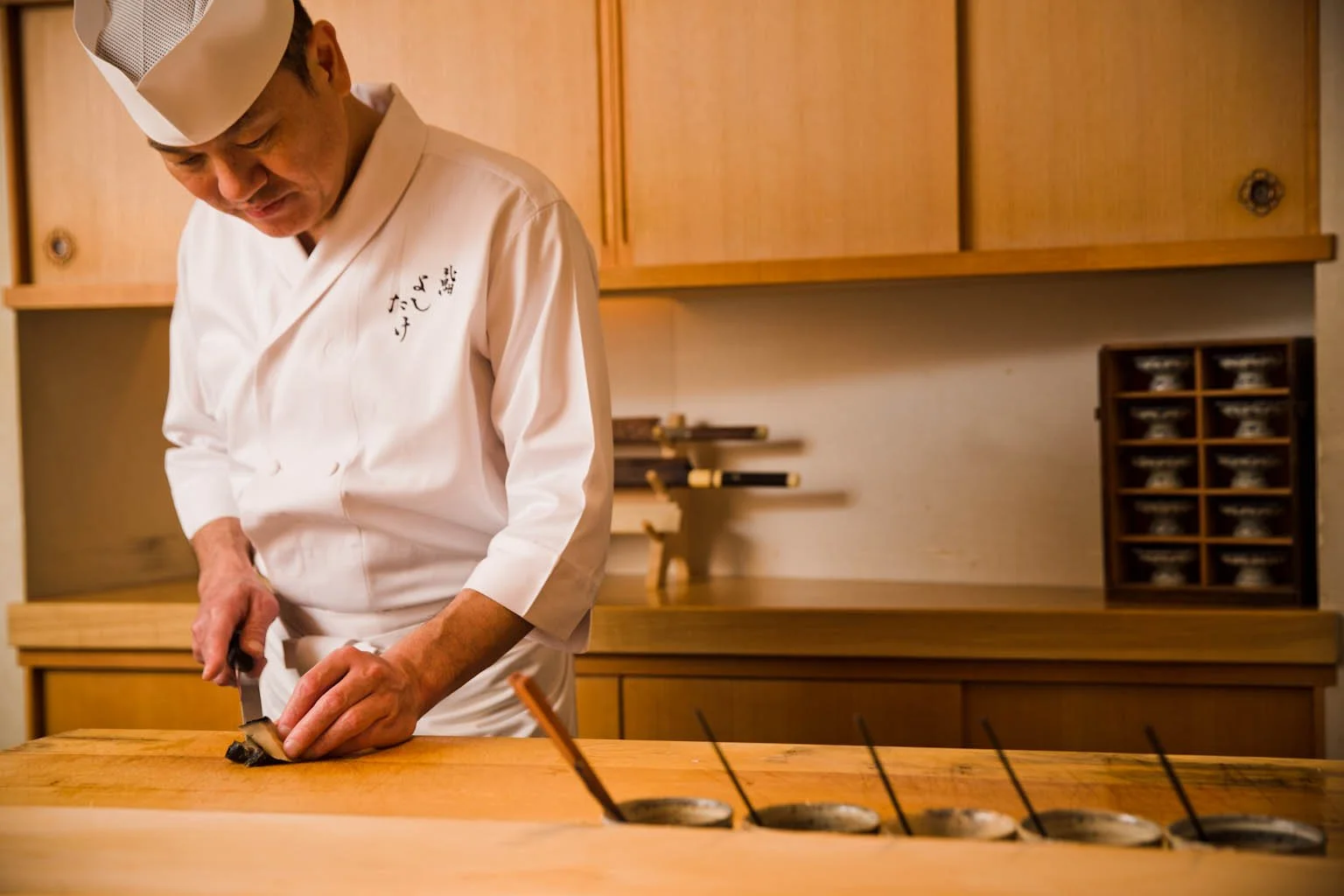
That curiosity begins to dissipate, however, because the next twenty minutes are devoted entirely to slicing, arranging and preparing. Since not only Yoshitake but all five chefs are occupied with this task, what unfolds is not the meditative ritual of a master at work but, over time, a rather hectic bustle. By the time I have finished my second glass of Champagne and moved on to white wine, things finally continue.
The first nigiri served is ika, squid. I am surprised to see that Yoshitake appears to take the mollusc directly from the refrigerator just before serving, already fully prepped, and begins assembling it immediately. No tempering, nothing. And that is how it tastes. Too cold, too sticky, too firm. The rice has barely any acidity. To make matters worse, the nigiri falls apart in my hand the moment I try to pick it up gently but firmly between thumb and middle finger. I am forced to shovel the disintegrating chaos from my palm straight into my mouth. A deeply unfortunate opening to the nigiri sequence.
Isaki, also known as grunt or chicken grunt, is a quintessential Japanese summer fish and one I encounter here for the first time. Unlike sea bass or horse mackerel, other seasonal fish of the warmer months, its reddish-pink flesh carries a higher fat content. Yet in flavour it remains close to sea bass and is very mild.
With kinmedai, the sushi gains in intensity. Even though the splendid alfonsino is very good, it does not reach the extraordinary quality I enjoyed a few days earlier with Mitsuaki Tamura at Sushisai Wakichi in Sapporo. Added to that is the fact that Yoshitake’s rice does not appeal to me at all. First it was too cool; now it is too warm. And yet I did not see one of the chefs bring in a fresh hangiri, the wooden rice tub. Very strange. Equally, the rice lacks the vinegar that, for my taste, is essential to creating balance.
Where the first nigiri barely showed any acidity in the rice, it now suddenly leaps at me. Although I am watching Yoshitake fairly closely, I cannot see whether perhaps he has two hangiri in front of him or whether one of his assistants has indeed passed him a fresh one. Whatever the case, what the rice lacked in acidity before it now possesses in aggressively excessive form. Theoretically, I understand the idea that a fattier fish such as bonito should be countered by slightly sharper rice. In practice, though, it does not work here at all. To make matters worse, the neta is far too generously portioned.
The tuna sequence begins with akami, the lean cut from the back. The poor fish has no chance against the violent acidity of the rice.
Chutoro, the medium-fatty belly, naturally handles it a little better. But harmony is still nowhere to be found.
With otoro, the fatty belly, one might assume the fish could carry such acidity. But with this rice, genuine pleasure seems impossible to generate, let alone experience. Although the tuna is of very good quality, it does not reach benchmark level. Which is notable, because Yoshitake is actually known for being one of the very first masters at the market in the early morning in order to secure the best pieces.
At this moment, I am genuinely perplexed. In my view, this cannot be intentional. The other guests do not seem surprised. Well then. Onwards.
Kasugo, young sea bream, signals yet another abrupt turn. For the first time, the rice is reasonably well seasoned. The fish, too, pleases thanks to clearly perceptible umami. The temperature of both elements is around lukewarm. It's genuinely tasty.
Then comes aji, horse mackerel. Here, finally, everything clicks. The fish is rich, lightly sweet and pleasantly oily, while the perfectly tempered and portioned rice counters it with precision. Balanced, rounded - this is how it should be.
The bafun uni is generously packed by Yoshitake into a gunkan-maki. For this, the rice is shaped into a cylinder and wrapped in a sheet of nori, leaving an opening at the top into which the sea urchin gonads are spooned. The play of texture is especially welcome here, since the nori brings a certain crunch and thus some variation to the menu.
Kurumaebi, Japanese tiger prawn, is taken from the refrigerator moments before serving, just like the squid. The prawn, which ought to be a thing of beauty, looks grey and dull and tastes that way too.
At least the anago, saltwater eel, manages to steer the meal somewhat back on course.
The carelessly put-together temaki, a hand roll with tuna, is too cold, which by this point will surprise absolutely no one.
By the time I have finished the tamagoyaki - too firm, and for my taste too heavily scented with dashi - I am simply glad that the meal at Yoshitake’s counter is over.
Rarely before has a meal left me so bewildered and, to a certain extent, frustrated. Masahiro Yoshitake is without question a highly capable cook. He showed that above all in the appetisers this evening. But in his chosen speciality, sushi, he convinced very little. Michelin seems to have been less puzzled than I am. That no stars now shine above what was once assumed to be Tokyo’s finest sushi-ya is, after this erratic dinner, something I can entirely understand.
To bring the evening to as frustration-free an end as possible, I head back upstairs to Bar Midair. A bottle of Champagne, the view of Tokyo Tower, and a lively exchange with the exceedingly likeable sommelier Fumiya Shibata ensure that the evening slowly turns into night. And in the end, it does still finish on a high.
Sushi Yoshitake
Brown Place 9F
7-8-13 Ginza
Chuo-ku
Tokyo
Japan
Book a table - Sushi Yoshitake
03-6253-7331
Titelbild und Foto von Masahiro Yoshitake © Tableall