Gion Nishikawa (Masayoshi Nishikawa) - Kyoto
Gion Nishikawa - Connect Four
Kyoto is the birthplace and spiritual home of traditional kaiseki cuisine, the Japanese equivalent of French haute cuisine, if you will. Unsurprisingly, the former imperial capital is home to an extraordinary concentration of highly decorated restaurants, which hardly makes choosing where to dine any easier. In many cases, however, the restaurants make the shortlist for you by refusing reservations from certain guests altogether. I wrote about that phenomenon in my review of the disappointing Sushi Yoshitake in Tokyo. As a result, several restaurants at the top of my wish list quietly eliminated themselves before I ever had the chance to book them.
This is why I land on Gion Nishikawa surprisingly quickly. Alongside its two Michelin stars - still my primary point of reference in Japan - the restaurant enjoys an excellent reputation on Tabelog, Japan's leading restaurant review platform. It holds a Bronze designation, which, in Tabelog's own words, is reserved for "outstanding restaurants that are essential destinations for fine dining and food enthusiasts." It is also included in the coveted Japanese WEST 100, a list recognizing the hundred highest-rated restaurants serving refined Japanese cuisine like kaiseki across western Japan, including Hokuriku, Kansai, Chūgoku, Shikoku, Kyushu, and Okinawa. Considering that more than 20,000 restaurants fall within this category, Gion Nishikawa ranks among the top half percent. Combined with its two Michelin stars, expectations of an exceptional meal seem more than justified.
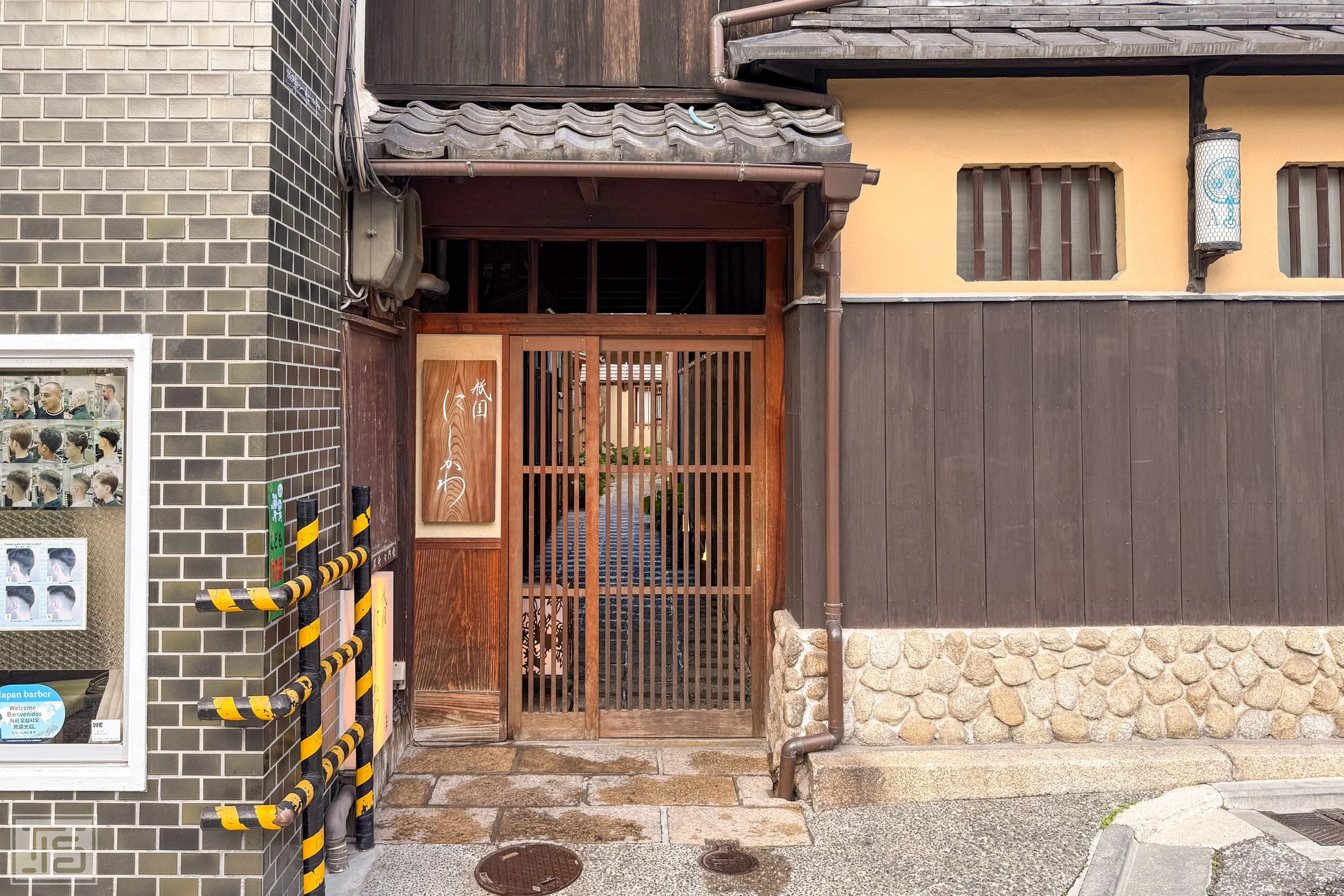
Kyoto is oppressively hot today, making me particularly grateful that taxis in Japan are generally plentiful, reliable, and reasonably priced. Still, even in the Land of the Rising Sun, not everything is perfect. Kyoto is an old city, and that age occasionally shows. Not only in its public transport but also in the fleet of decidedly vintage taxis, some of which seem to regard air conditioning as an optional feature. Whenever I happen to end up in one, I miss Tokyo even more than I usually do. By the time I arrive at Gion Nishikawa, the combination of relentless heat and an underperforming AC has drained any enthusiasm for sightseeing. I settle for a quick photograph of the entrance before escaping into the restaurants.
Or rather, into the building first. Gion Nishikawa is divided into several spaces: a number of private dining rooms, used primarily by Japanese guests, and the main counter overlooking the kitchen, where I'll be spending the evening. The interior immediately stands out. Designed in the sukiya style that evolved from traditional Japanese tea houses, it makes extensive use of bamboo and Japanese cypress. This style feels deliberately rustic, emphasizing harmony, simplicity, and a close connection to nature. The very same ideals that define kaiseki cuisine through its uncompromising devotion to seasonality.
There is barely time to admire the architecture before attention shifts to more pressing matters. Drinks first. Since the wine list is fairly modest and I've had consistently good experiences with sake and wine pairings in Japan, I choose this option. Moments later, the opening refreshment arrives.
A chilled drink of sansho pepper and apple immediately eases the lingering heat, refreshing not only the palate but the mind as well.
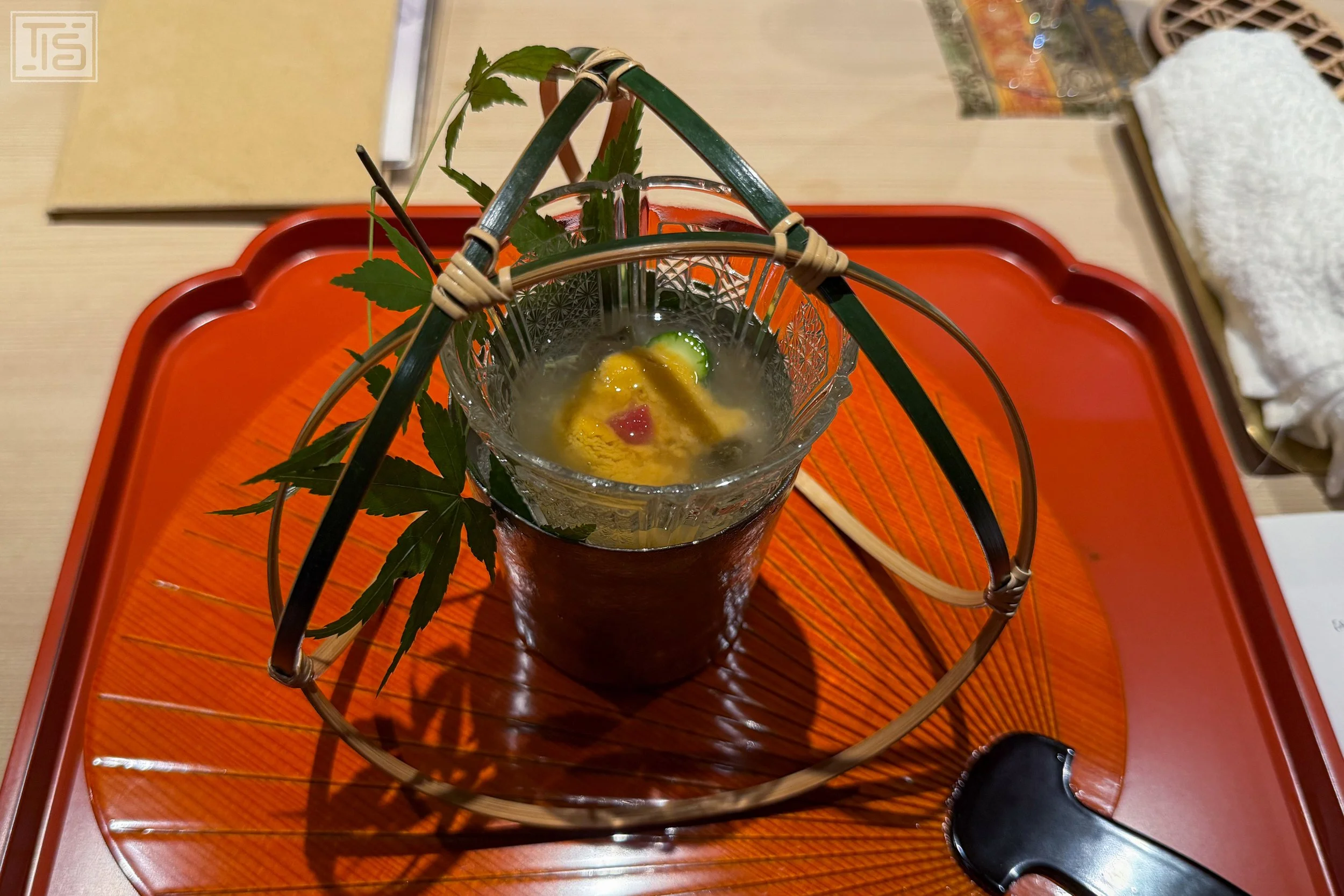
After that light-footed introduction, Nishikawa wastes no time raising the stakes. Jun sai (water shield), sea urchin, pickled plum, and cucumber is served equally cold, but proves far more intricate and intellectually engaging. Outside Japan, water shield is rarely encountered, and apart from its faint bitterness and the gently thickened texture created by its natural mucilage, it remains largely in the background. The Bafun uni from Hokkaido, by contrast, takes center stage. Its sweet, iodine-rich character, evoking brackish seawater, is balanced by the crisp freshness of the cucumber and the carefully restrained acidity of the pickled plum.
The quality of the ingredients is beyond question. Even so, I'm not entirely convinced that this presentation showcases the sea urchin to its fullest potential. Then again, perhaps I'm simply missing a cultural reference that would be immediately apparent to a Japanese audience.
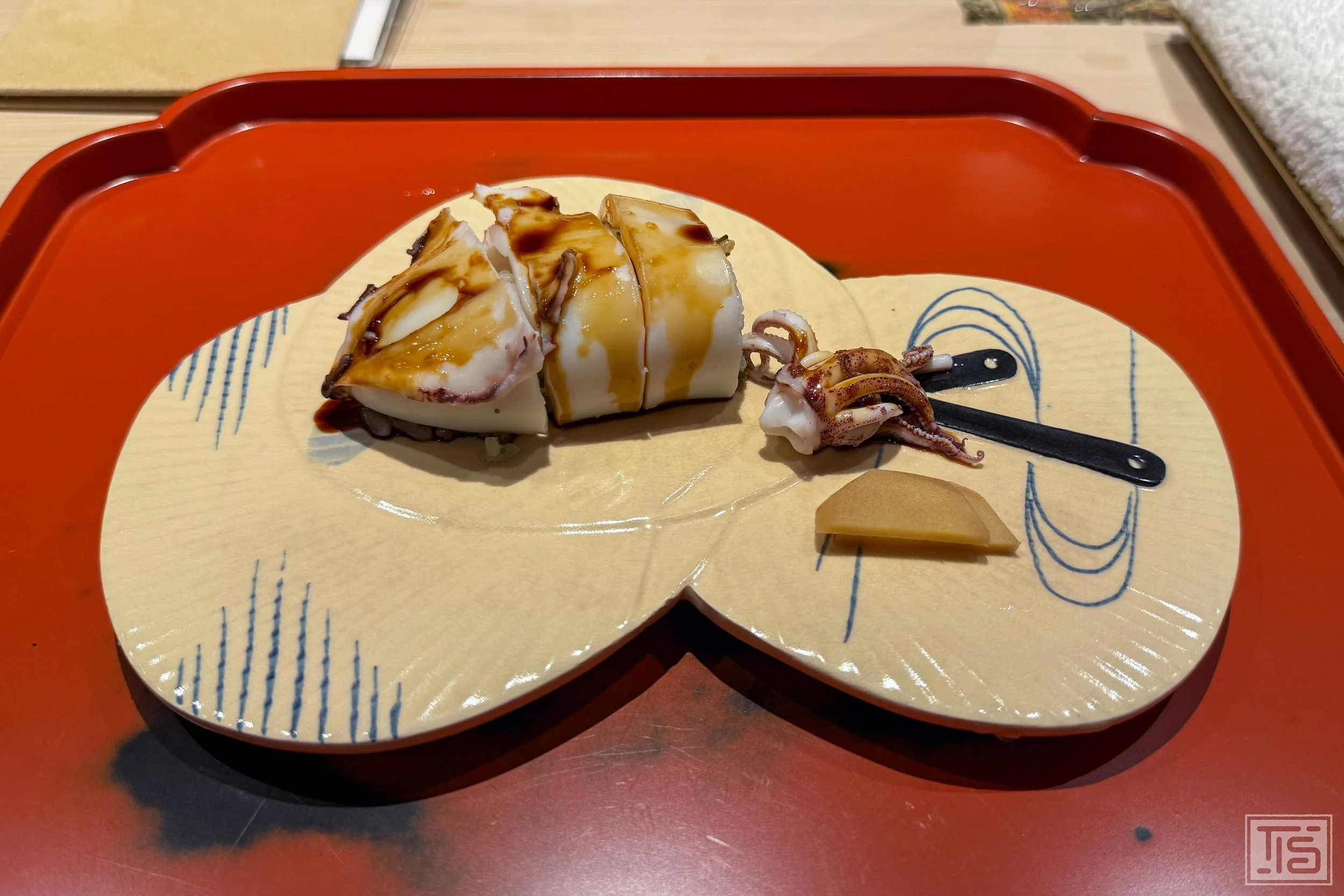
Next comes sushi. Aori Ika, more specifically. The bigfin reef squid is served over warm rice and generously brushed with soy sauce. Two slices of shin-shoga, young ginger, accompany it as a refreshing counterpoint.
The warmth transforms the squid, giving it a pleasantly springy bite and an almost meaty texture, while simultaneously emphasizing its natural sweetness. Deep umami from the soy sauce anchors the dish, and the young ginger contributes delicate citrus notes along with a gentle touch of heat. It is uncomplicated pleasure in the very best sense. Nothing more, and certainly nothing less.
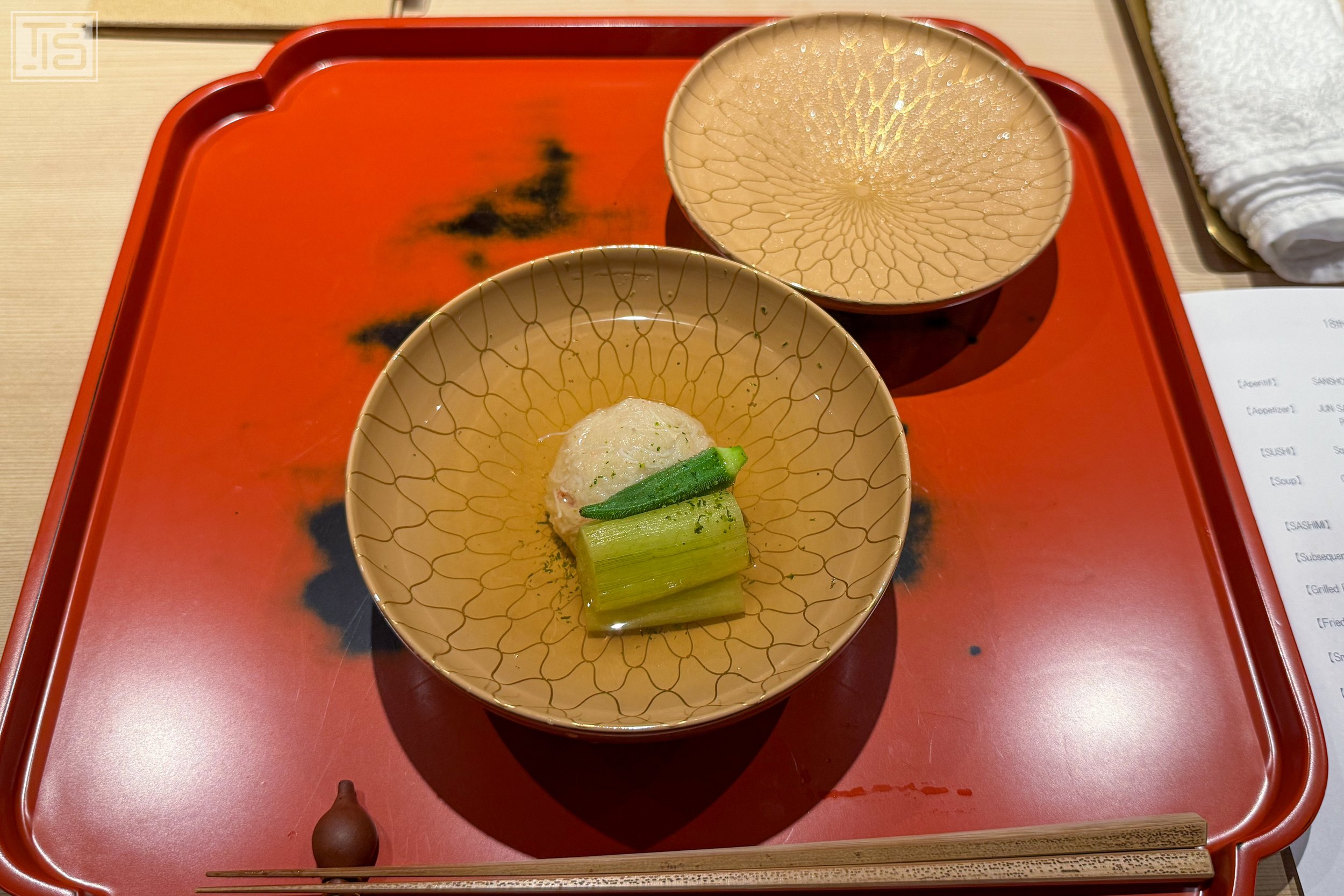
The clear dashi with lotus root cake, taro stem, and okra demands considerably more attention. At first glance it appears almost understated, but its sophistication gradually reveals itself with every spoonful. Each vegetable unfolds like a separate textural layer. First comes the bite - every component retains remarkable crispness, though each in its own distinct way - before slowly revealing its subtle individual flavor.
In almost any other setting, the beautifully clear, impeccably seasoned broth would be the undisputed focal point. Here, however, it serves primarily to season and elevate the vegetables themselves. How Nishikawa manages to imbue such a quiet dish with this degree of concentration and almost electric tension is nothing short of remarkable. I find it deeply moving.
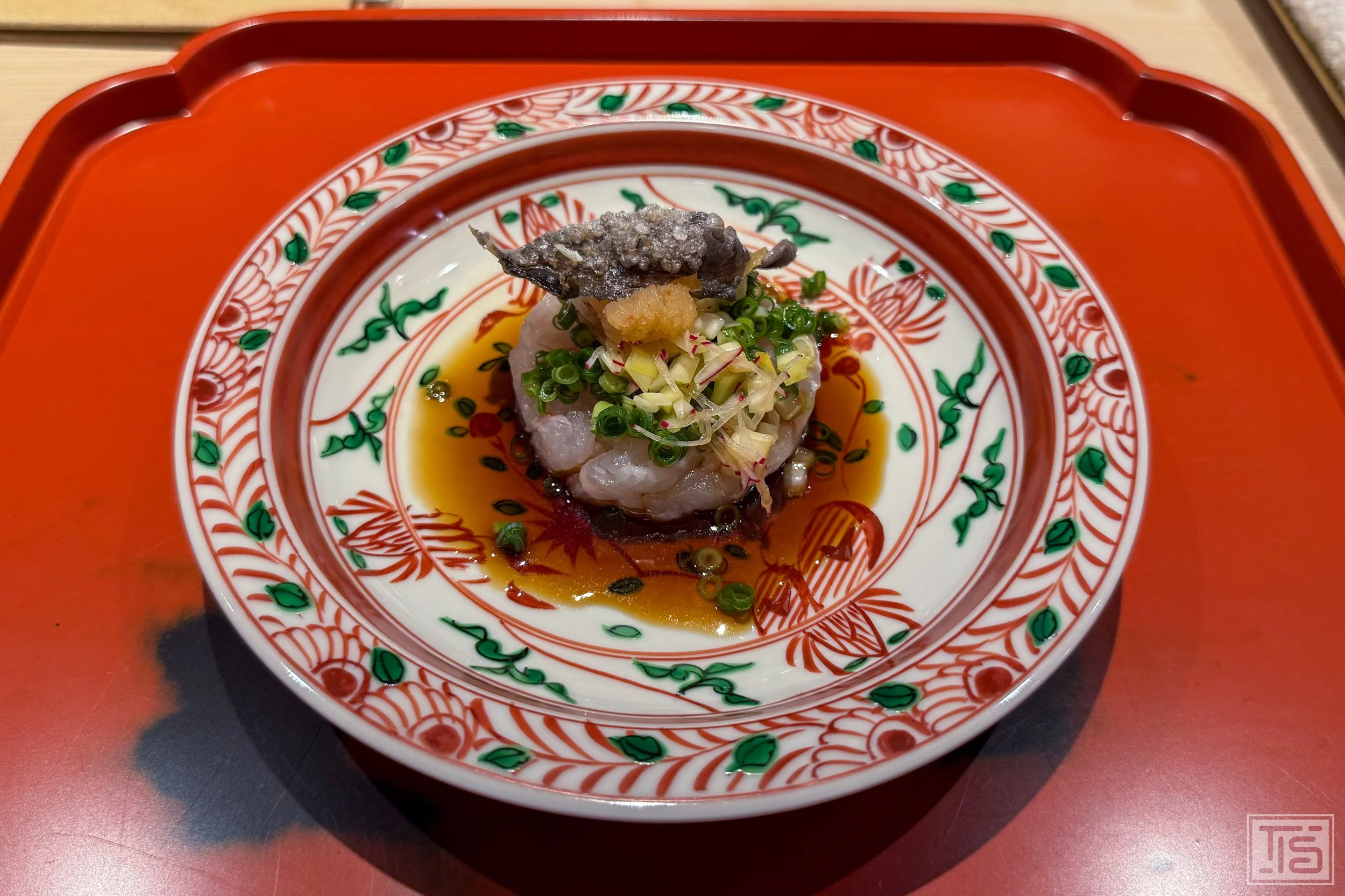
The meal now moves into Mukōzuke (向付), the traditional sashimi course of a kaiseki menu. Nishikawa interprets it rather freely, transforming it into an entire sequence instead of a single presentation.
The first installment features hamo, or pike conger. Much like the squid before it, the presentation feels deliberately rustic and surprisingly substantial. Something that gives me slight pause this early in the menu. That impression carries through on the palate. The fish is rich, intensely savory, and notably full-bodied, contrasted by an entire spectrum of radishes served raw, cooked, and pickled, together with generous amounts of young spring onions and soy sauce. Unexpectedly, the dominant associations that come to mind are coffee and dark chocolate. It's certainly surprising, but at this stage I find myself wishing for more freshness. For my taste, the dish leans a little too dark and a little too rich.
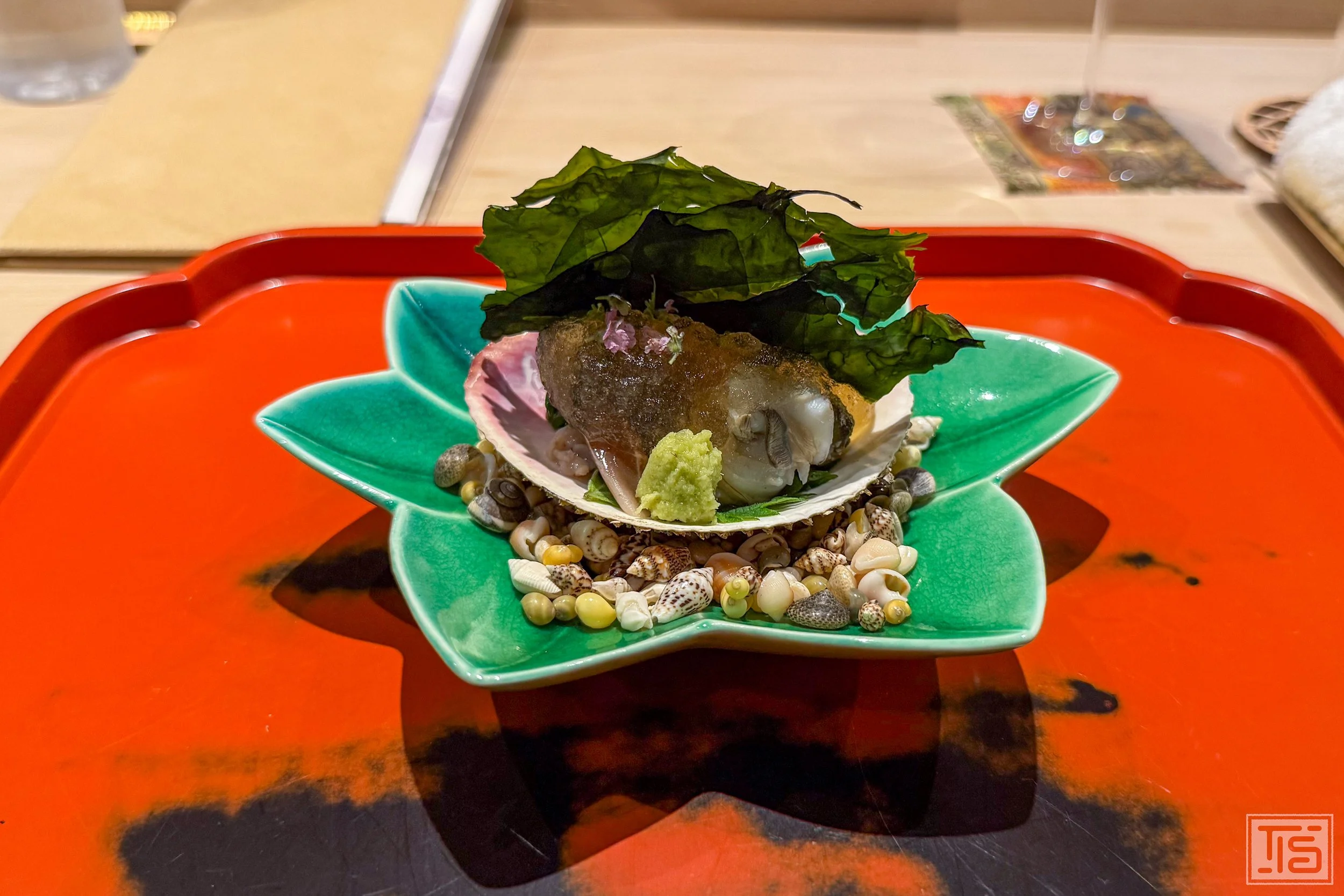
Next comes torigai, the Japanese cockle. Once again, the portion is remarkably generous, accompanied by an equally liberal amount of freshly grated wasabi, a shellfish gelée, and dried shiso leaves.
It's not immediately clear whether the leaves are intended as garnish or part of the dish, so I happily experiment with different combinations. The shellfish, however, is served extremely cold. As a result, even powerful elements such as the equally chilled wasabi seem muted, making the overall composition difficult to judge. Sampled on its own, the shellfish gelée hints at genuine brilliance, which only makes the dish's restraint all the more frustrating.
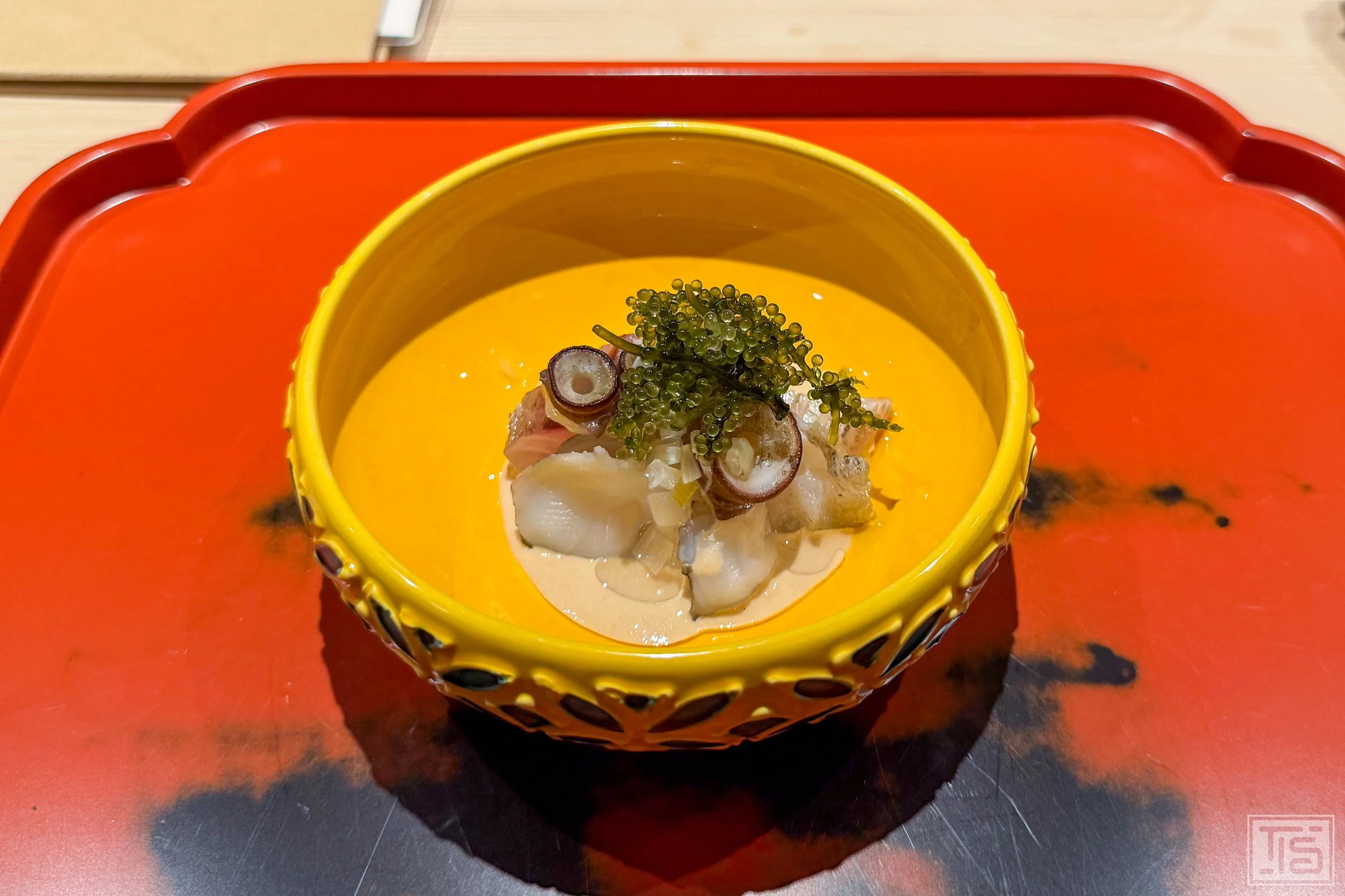
The final installment of the Mukōzuke sequence also proves to be its finest. Tako (octopus) and aji (horse mackerel) arrive together, and upon asking, Chef Nishikawa confirms that the octopus is intentionally cooked to retain a firm bite before being finished over binchōtan charcoal. The extended grilling lends it a wonderfully appetizing hint of campfire smoke without overwhelming its naturally sweet and meaty flavor.
In contrast, the horse mackerel is delicate and almost startlingly evocative of the sea in midsummer. Crisp sea grapes amplify that impression even further, adding bursts of salinity and texture. Equally unexpected - and entirely successful - is the accompanying goma dare, the Japanese sesame sauce more commonly associated with shabu-shabu. Its focused nuttiness, profound umami, and savory depth transform the composition, giving the dish an entirely different dimension. While the first two Mukōzuke courses left me somewhat underwhelmed, this small masterpiece lands squarely on target.
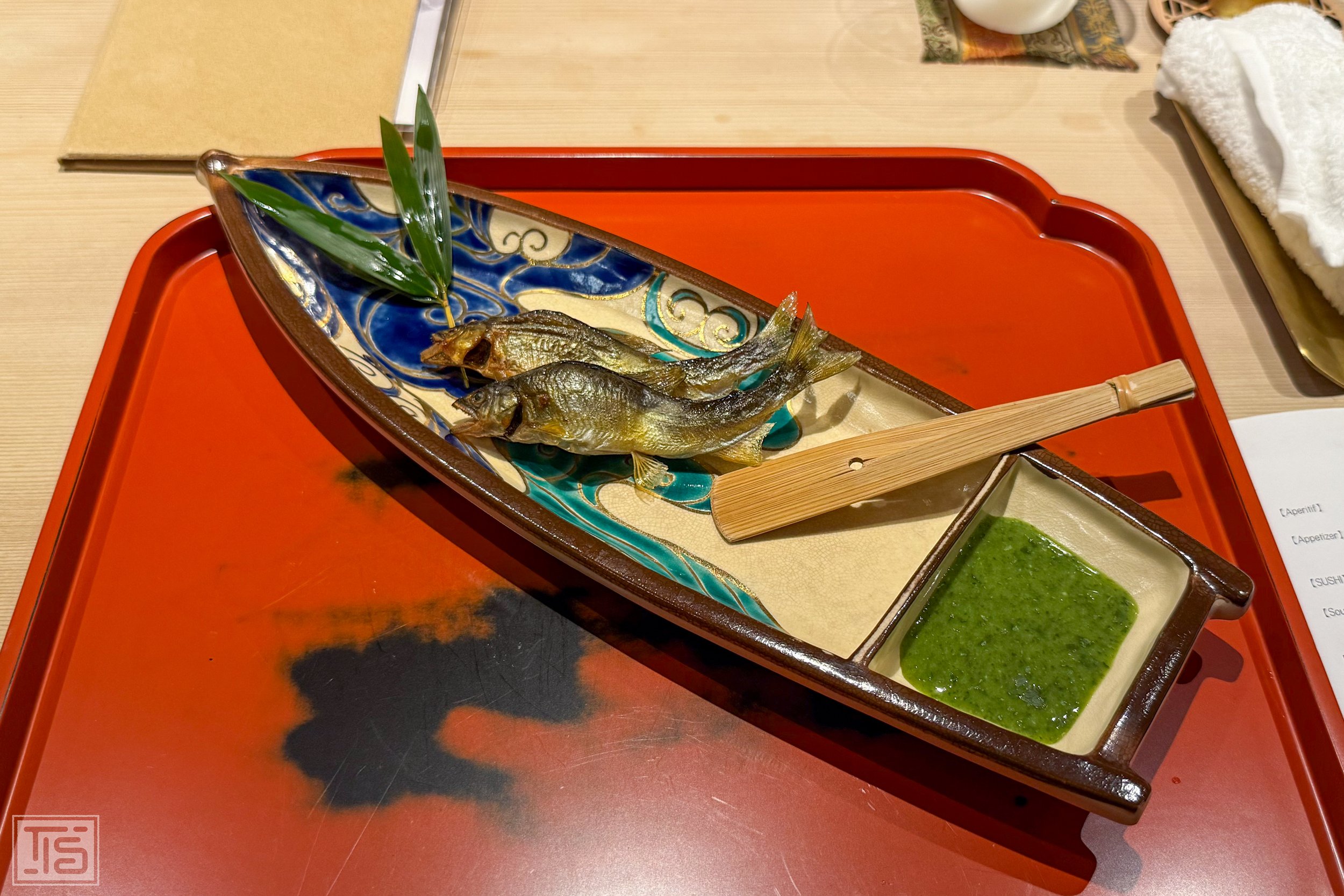
Ayu, or sweetfish, follows with a refreshing herb sauce. While the fish were being grilled over charcoal and subsequently smoked with tea leaves, the entire restaurant briefly disappeared into a dense cloud of smoke. Judging by the chefs' reactions, this had not exactly been the intended outcome, prompting a good-natured round of teasing directed at the grill master - led, naturally, by Nishikawa himself.
The slender fish are traditionally skewered in a way that makes them appear to be swimming when served. They are presented whole, without being gutted, and eaten from head to tail. Much of their appeal lies precisely in that rustic completeness: the crispness of the tiny bones and head, followed by the pleasant bitterness released by the liver and stomach. Smoke from the grill reinforces those flavors, while tadesu (蓼酢) - a tart, herbal sauce made from crushed water pepper leaves and vinegar - adds another layer of sour, bitter freshness. Together they create a striking counterpoint to the naturally sweet flesh, which explains why the fish is aptly known in English as "sweetfish." Although this seasonal delicacy appears on menus throughout Japan during the summer months, I never tire of its honest, rustic simplicity.
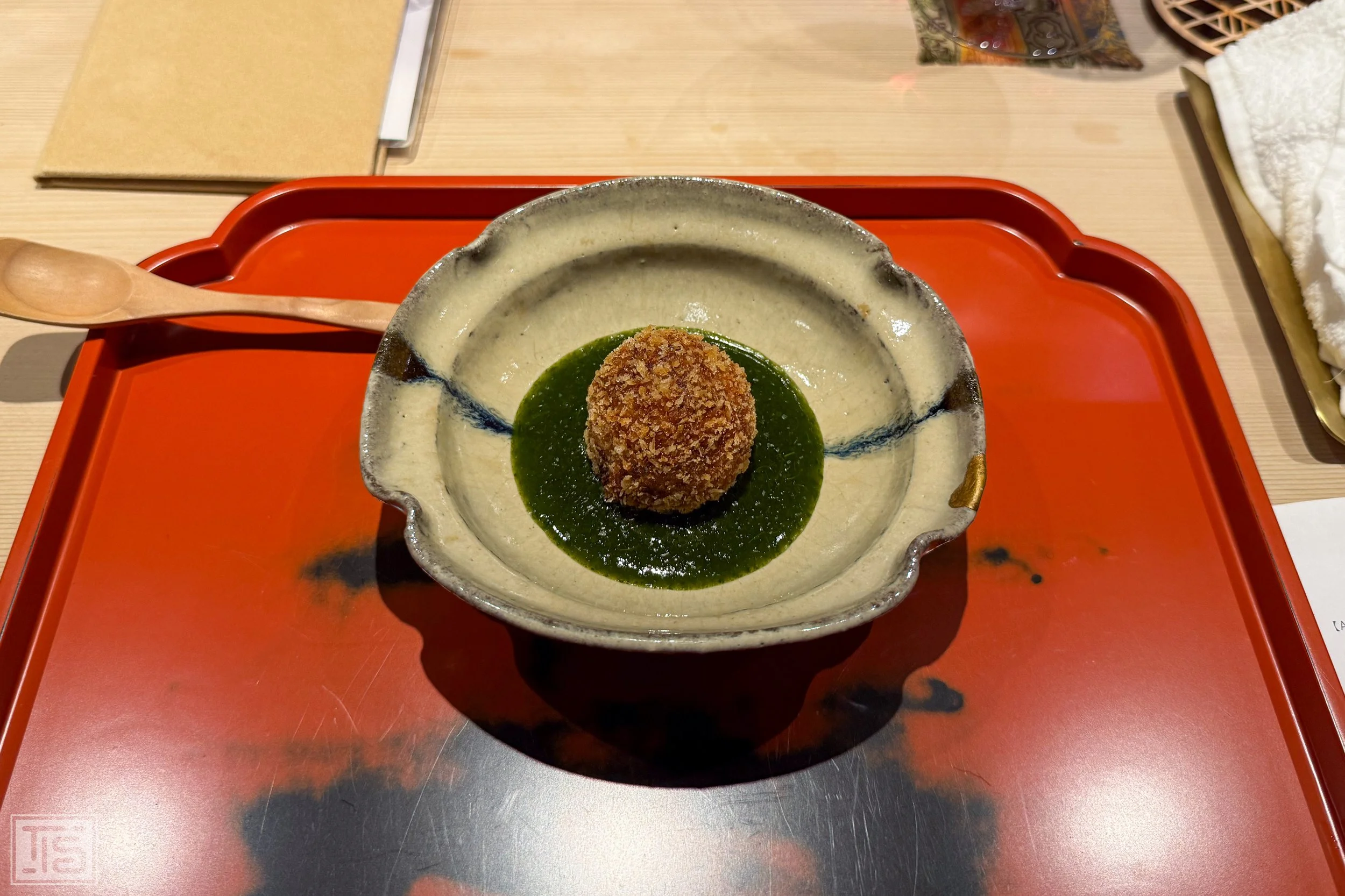
A croquette of aged potatoes with Japanese spinach hardly sounds like one of the meal's defining moments. In reality, it is nothing short of spectacular.
It begins with flawless craftsmanship. The crust is impossibly thin and perfectly even, its crunch heightened by a coating of panko breadcrumbs. Inside is piping hot mashed potato whose gentle aging has developed faint lactic notes, lending the filling a surprising depth and complexity. The accompanying Japanese spinach - more precisely, Japanese mustard spinach - contributes depth of its own. More assertive than conventional spinach, it carries subtle hints of cabbage along with the faintest touch of peppery heat. That vibrant green freshness provides exactly the balance the croquette needs.
It is one of those dishes that defies easy description. All I know is that I won't forget it.
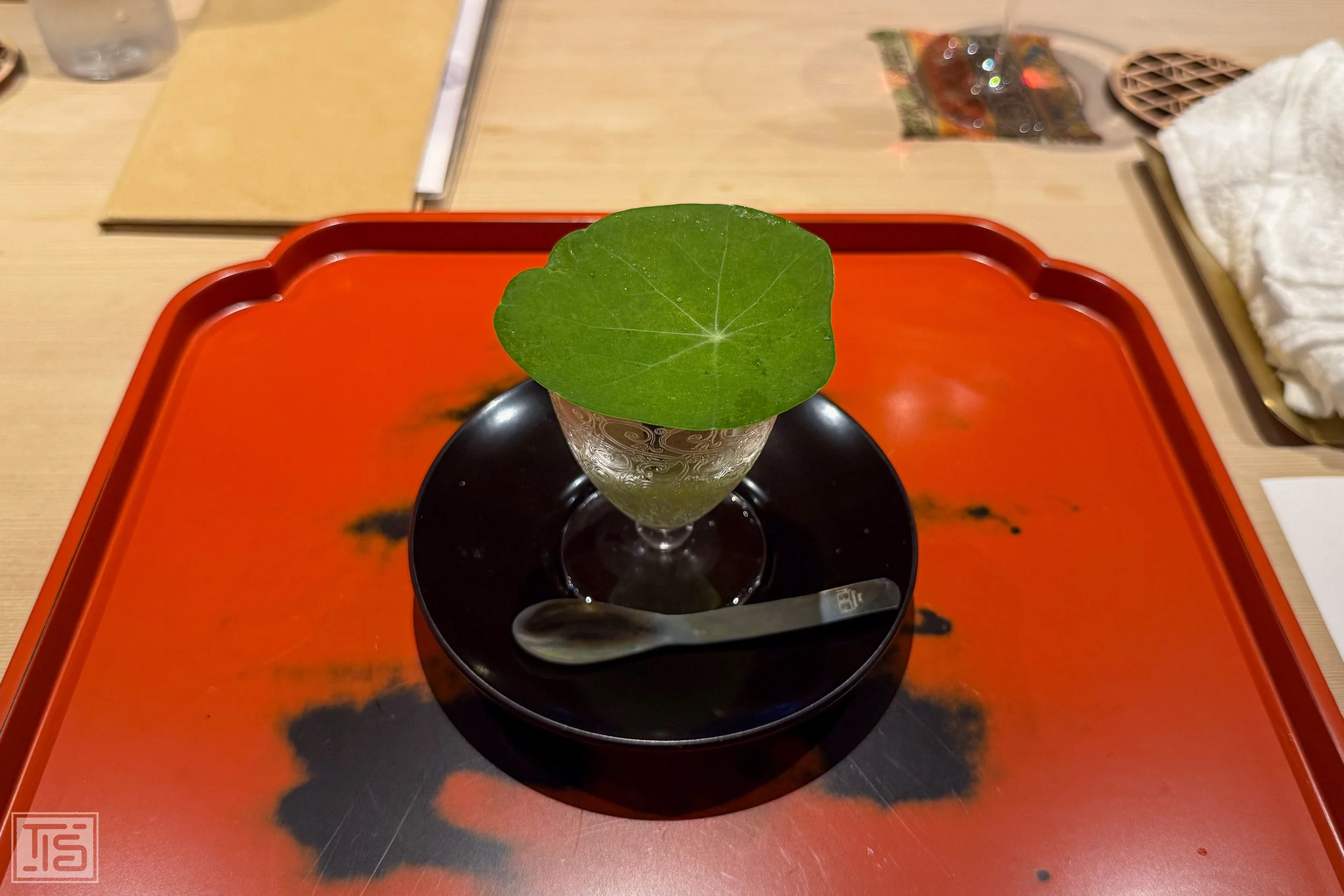
Before the main courses begin, the Naka-choko (中猪口) arrives - the kaiseki equivalent of a palate cleanser.
Grated winter melon is paired with a small amount of unsalted Chinese caviar. Resting atop the beautifully decorated glass is a single nasturtium leaf that has been lightly misted with spring water immediately before serving. The droplets are meant to evoke morning dew settling on a lotus leaf, symbolizing freshness and renewal. The winter melon itself has been briefly cooked in dashi. Mild in flavor and faintly reminiscent of cucumber, it has been perfumed with yuzu. Much like the opening sansho and apple drink, it refreshes both palate and mind in equal measure, gently preparing them for the final third of the menu.
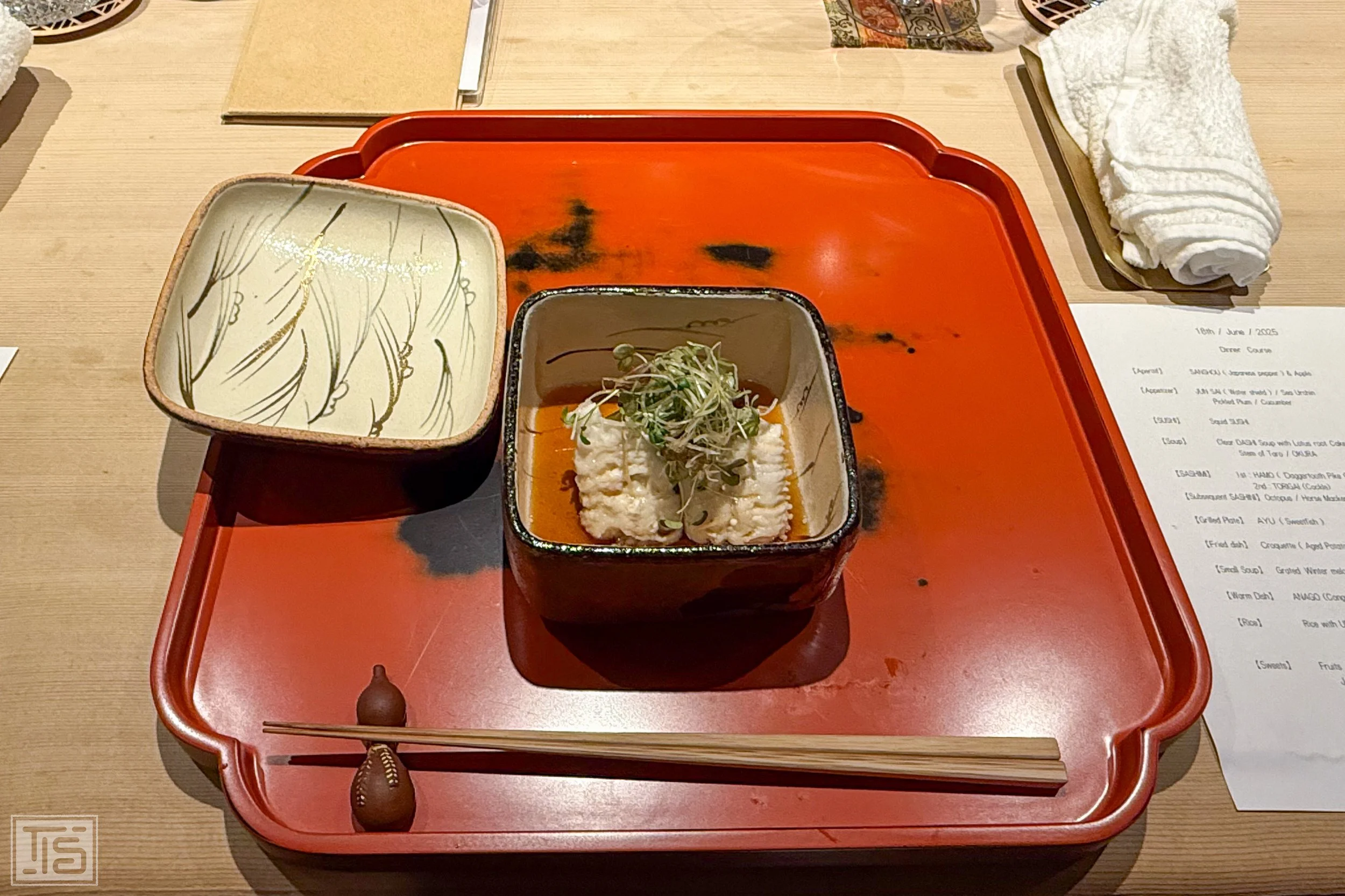
The first of the main courses impresses in two equally compelling ways.
The anago is, quite simply, probably the finest eel I eat during my entire trip to Japan. Rich without becoming heavy, deeply flavorful yet remarkably elegant, it possesses an utterly captivating texture. Much of that can be attributed to the distinctive namiuchi-giri cutting technique. The wave-like scoring loosens the fish's muscle fibers, making the flesh noticeably more tender while simultaneously creating tiny channels that capture more of the accompanying sauce. Yet the eel almost has to share the spotlight. Beneath it lies a piece of aubergine unlike any I have encountered before, remarkable for both its extraordinary texture and astonishing depth of flavor. Throughout my journey I am served both eel and eggplant countless times, but never in this singular expression of either ingredient, nor in such perfect harmony together. The only additions are crisp, gently bitter kaiware daikon sprouts and a light usukuchi dashi made from ichiban dashi, soy sauce, mirin, and sake. They contribute precisely the freshness the dish requires without ever distracting from its two protagonists, supporting rather than competing with them.
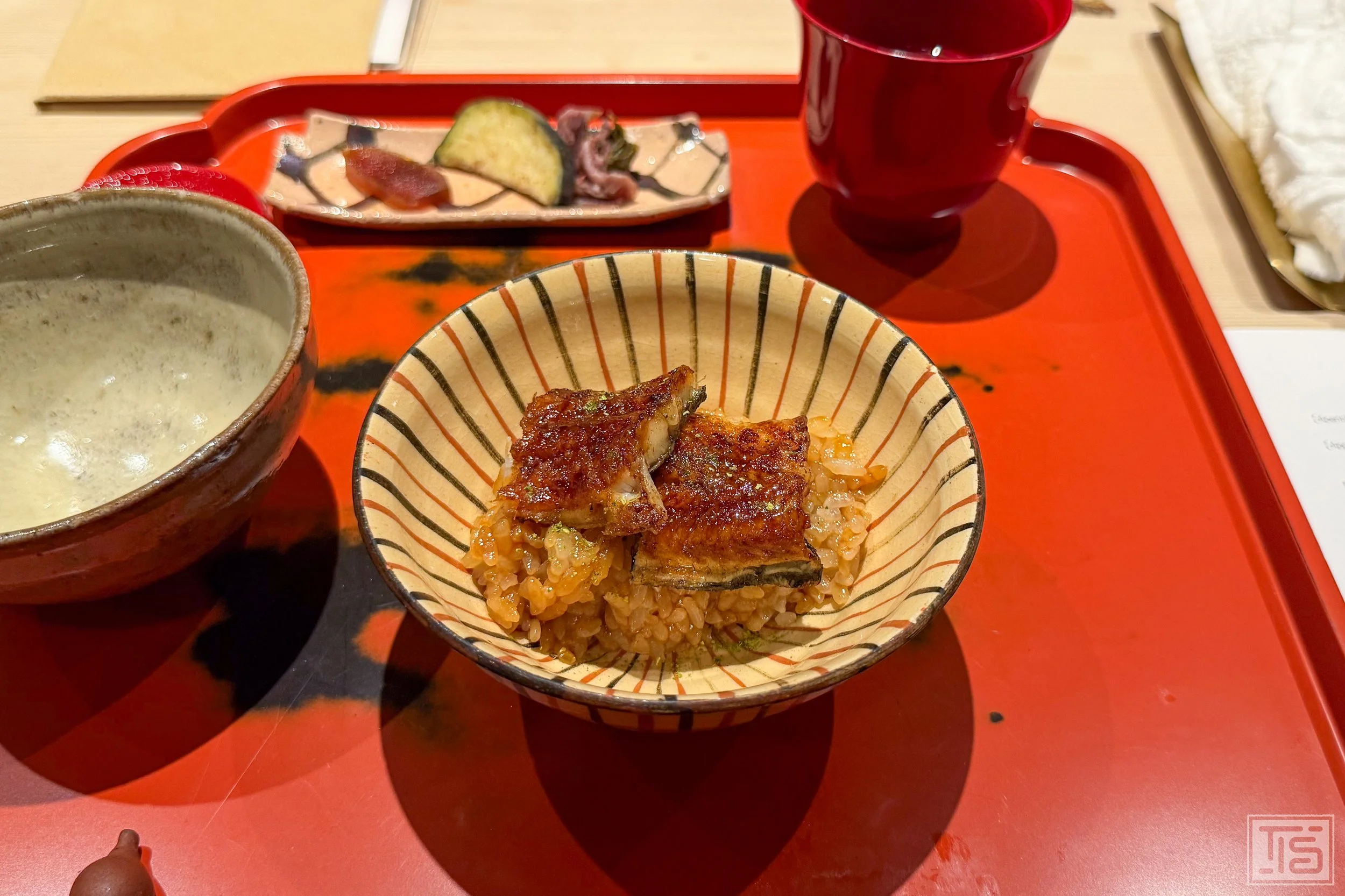
Traditionally, the savory portion of a kaiseki meal concludes with Gohan (御飯). During my travels through Japan, I quickly learned that this final rice course can take remarkably different forms. Sometimes it is nothing more than a modest bowl of pristine white rice. Elsewhere, it becomes an intimidating feast in its own right, arriving as an enormous bowl laden with toppings, accompanied by an overwhelming assortment of pickles and, naturally, a bowl of miso soup - essentially an entire lunch served after an already elaborate menu.
Nishikawa chooses both options. First, a small bowl of pristine white rice is served (not pictured). It is glorious in its delicate simplicity. Each grain is cooked to perfection. Next comes the feast version, but the portions are admirably restrained, keeping everything comfortably manageable. Personally, I would have been perfectly content with nothing more than a small bowl of plain rice at this stage. Yet his interpretation, built around unagi (freshwater eel), demonstrates exactly why this course deserves its place. The eel is phenomenal. Intensely savory, richly seasoned, profoundly umami-driven, luxuriously fatty—utterly delicious. The rice itself, flavored with soy sauce and eel fat, is equally impressive, every grain again cooked with absolute precision. Alongside it, the pickled vegetables (Kō no mono) and the red miso soup (Tome-wan) complete a deeply satisfying finale to the savory courses.
Come to think of it, this entire ensemble would also make the ultimate hangover breakfast. I'm convinced it could bring almost anyone back to life.
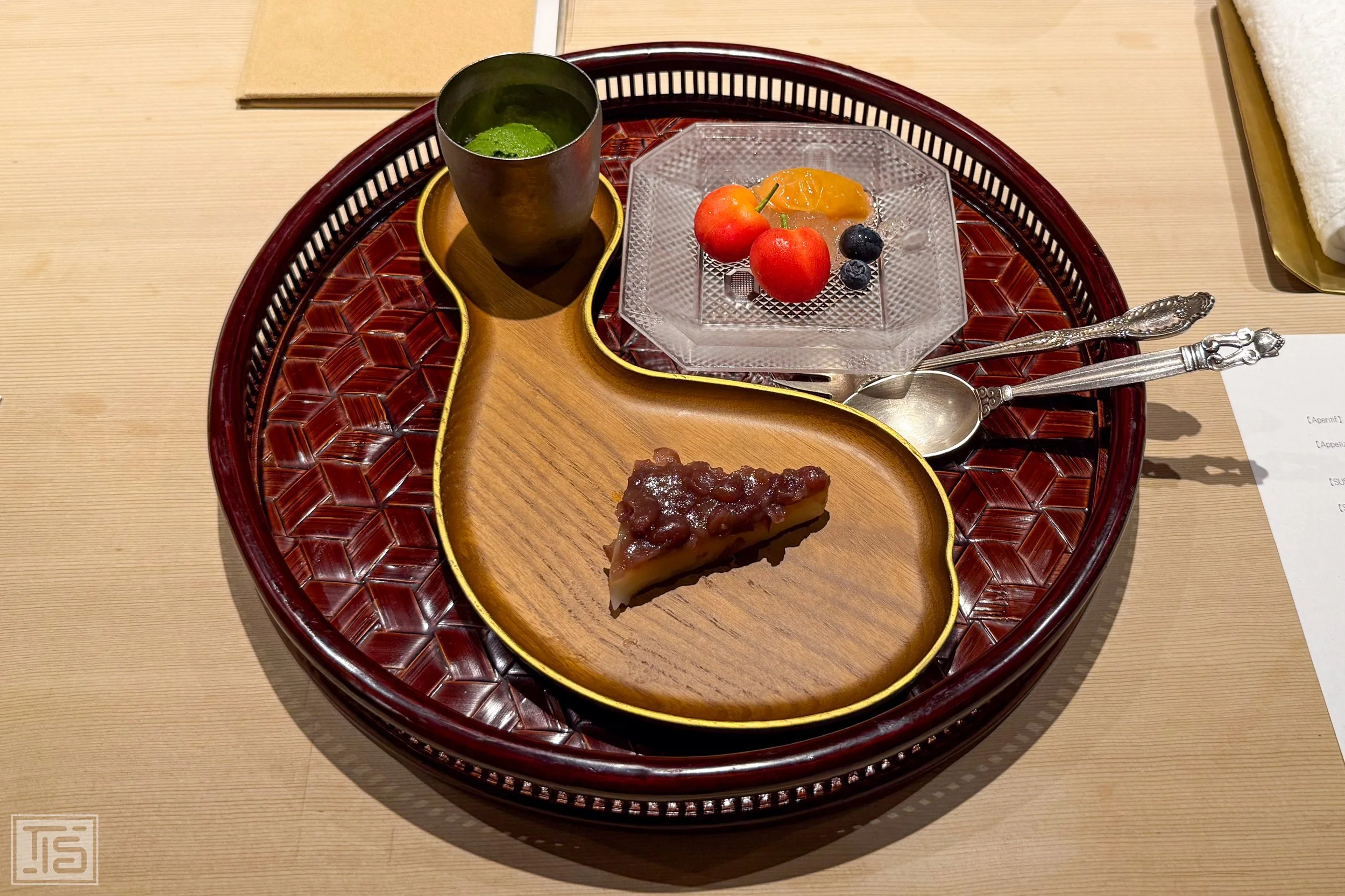
A small assortment of fruit, matcha ice cream, and a selection of "Japanese sweets" marks the the dessert course.
The confection at the bottom of the picture is Minazuki, a traditional sweet consisting of a triangular piece of Uirō - a steamed cake made from glutinous rice flour and sugar - topped with azuki beans. It is excellent, and exactly the sort of dessert I enjoy: restrained in sweetness and built around a flavor profile that feels refreshingly unfamiliar. The fruit, unfortunately, proves disappointing. Everything is served far too cold, but more surprisingly, the quality itself falls short. The cherries are sour, the blueberries taste of virtually nothing, and a lightly pickled peach is similarly devoid of character. A real shame. The matcha ice cream, on the other hand, is magnificent. Fresh, vividly green, invigorating, and wonderfully creamy. Exactly what it should be.
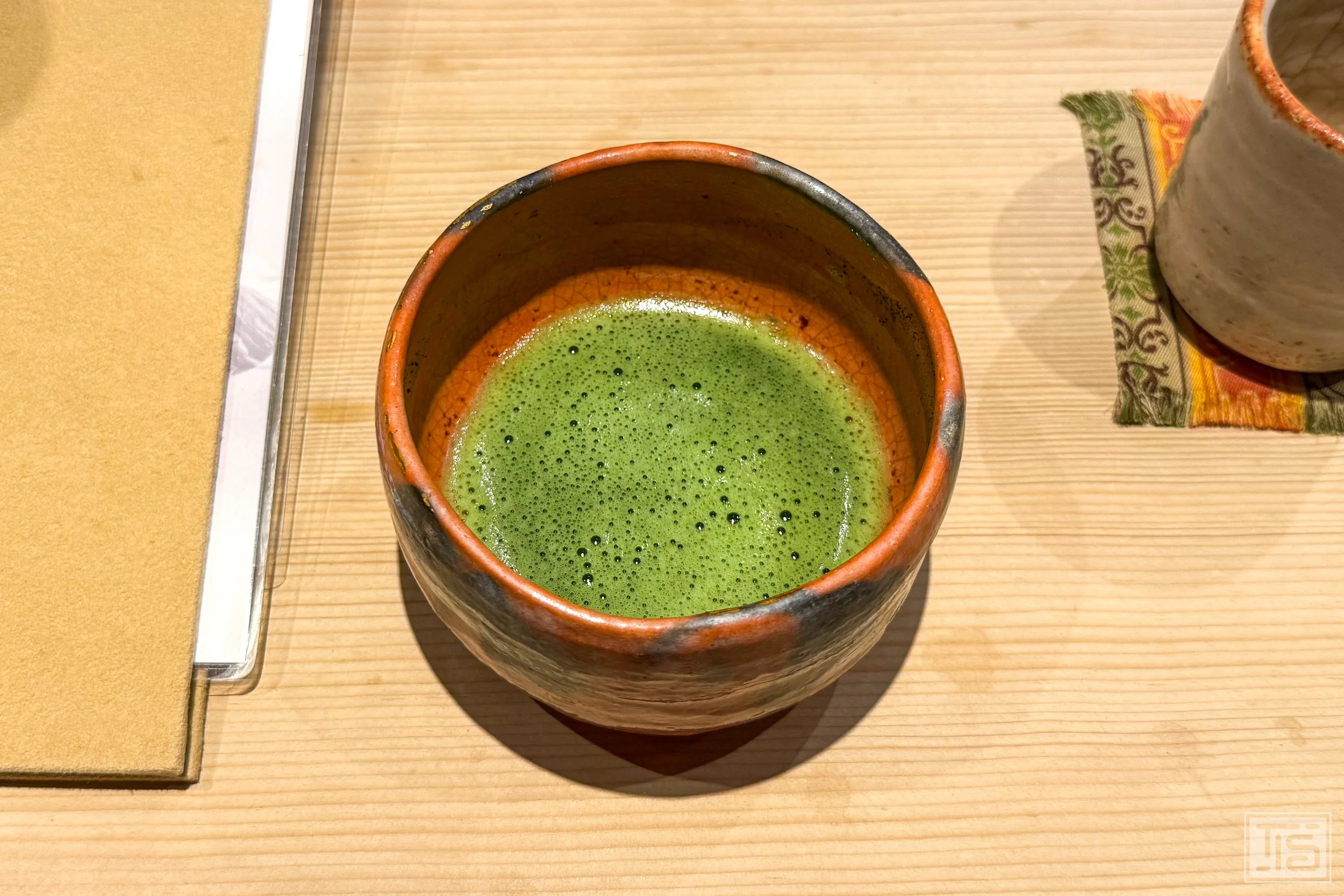
Naturally, the meal concludes with a bowl of freshly whisked matcha, a tradition I have grown very fond of during my travels through Japan.
Stepping back outside after the warm green tea, Kyoto is still sweltering despite the late hour. Fortunately, the wait is brief, and this time the taxi's air conditioning actually works. With a cool head at last, I replay the evening on the drive back to my Machiya.
In many ways, Gion Nishikawa is a quintessential modern two-star restaurant. Some dishes clearly fall short of the standard, some perform exactly at the level one expects, and a select few hint at the potential for something even greater. What sets this meal apart, however, is the sheer number of truly unforgettable highlights. The two eel courses, the potato croquette, and the lotus root cake are four creations I am certain I will remember forever. Even many three-star restaurants fail to leave that kind of lasting impression. Those four dishes alone justify making the trip, although based on this particular menu I would certainly not expect a third Michelin star to be imminent.
Masayoshi Nishikawa himself only adds to the experience. Despite the language barrier, he makes a genuine effort to engage with every guest seated at the counter. After serving the potato croquette, for example, he asks everyone how to say jagaimo (じゃがいも) - potato - in their native language. Spanish, Mandarin, Korean, French, German, and even Swiss German all draw delighted reactions from him. The chefs join in genuine laughter with their master, creating an atmosphere that feels relaxed, spontaneous, and authentically joyful. That lighthearted mood effortlessly carries over to the international guests gathered around the counter.
A handful of unforgettable dishes, shared laughter between chefs and diners, and the quiet sense that everyone in the room is enjoying themselves - that, in the end, is what makes for a truly memorable evening.